10 Types of Tube Bending: Methods, Mechanisms, and Applications
Jump to section
Tube bending shapes metal tubes into precise curves, angles, or coils used in industries like construction, automotive, and aerospace. It involves several methods—each offering different levels of precision, efficiency, and suitability for specific materials and applications. Understanding these techniques helps professionals choose the right process for safe, accurate, and cost-effective fabrication.
This process includes both cold and hot bending methods such as press bending, rotary draw bending, and roll bending. Supporting tools like mandrels and wiper dies improve accuracy and prevent defects in the bend area. These variations matter because each method affects the tube’s strength, surface quality, and dimensional consistency.
This article explains what tube bending is, how it works, and the seven main types used in modern metal fabrication. It also outlines how to choose the correct bending method, common bending defects and how to avoid them, and the materials best suited for each process.
What is Tube Bending and How it Works?
Tube bending is a metal forming process that changes a straight tube into a curved or angled shape. It uses controlled force to deform the material without breaking or flattening it. The goal is to change its direction or geometry while keeping the inner passage open and smooth.
This process depends on key factors such as bend radius, wall thickness, and material type. The bend radius (also called the center-line radius) is the distance between the bend’s center and the tube axis. A smaller radius produces a tighter bend but increases stress on the metal.
Different materials respond differently to bending. Aluminum is lightweight and flexible, making it suitable for gentle curves. Copper offers high ductility and supports tighter bends with less cracking. Steel and other metal tubes need more force and careful control to prevent deformation or wrinkling.
During bending, one side of the tube stretches (outer radius) while the other compresses (inner radius). This creates tension and compression forces that define the bend’s quality. Machines like rotary draw benders or press benders apply this force using dies and clamps that guide the tube’s shape. By managing these variables, fabricators produce precise, repeatable bends for products like automotive pipes, railings, and HVAC systems.

Types of Tube Bending Methods
Different tube bending methods vary in accuracy, cost, and material suitability. Each process uses distinct tooling and movement to shape tubes without compromising strength or dimensional tolerance. The choice depends on tube size, wall thickness, and the desired bend radius.
Below are 10 tube bending methods:
- Rotary draw bending
- Compression bending
- Roll bending
- Mandrel bending
- Induction bending
- Press bending
- CNC tube bending
- Stretch bending
- Ram (Push) bending
- Heat-Assisted (Hot) bending
Rotary Draw Bending
Rotary draw bending is a method that uses a rotating bending die to shape the tube while holding it tightly with a clamp die. This method provides precise and repeatable bends, ideal for complex or tight-radius shapes. The process keeps the inner and outer walls smooth and consistent.
It is commonly used in automotive exhaust systems, furniture frames, and aerospace components where exact angles are essential. The tooling setup includes a bending die, pressure die, and often a wiper die to prevent wrinkles.
Advantages of rotary draw bending:
- High accuracy and repeatability
- Supports multiple tube sizes and materials
- Produces smooth, consistent bends
Disadvantages of rotary draw bending:
- High tooling cost
- Slower setup for small production runs
Compression Bending
Compression bending is a method that works by pressing a stationary tube against a rotating die, forcing the material to form around it. This technique is simple and widely used in applications where appearance and precision are less critical.
It suits handrails, frames, and construction parts made from materials like aluminum or mild steel. Because it uses a single die, setup time is short, which lowers cost for low-volume jobs.
Advantages of compression bending:
- Quick and inexpensive setup
- Effective for mild bends and large radii
- Minimal tooling required
Disadvantages of compression bending:
- May cause ovality or flattening in the bend area
- Limited control over precision compared to rotary draw bending
Roll Bending (3-Roll/Pyramid Bending)
Roll bending, also called three-roll or pyramid bending, is a tube-bending process that uses three rotating rollers to gradually curve the tube into large-radius bends. The distance between the rolls and the pressure applied determine the bend radius and curvature.
This process is ideal for forming rings, arches, or large structural frames used in architecture and heavy industries. Because it can handle long tubes or large-diameter materials, it is often used for components like pipelines and curved railings.
Advantages of roll bending:
- Handles large tubes and long lengths
- Uniform curvature along the tube
- Cost-effective for large-radius applications
Disadvantages of roll bending:
- Not suitable for tight-radius bends
- Requires skilled setup for consistent results
- May need multiple passes to achieve the correct radius
Mandrel Bending
Mandrel bending is a tube-bending process that inserts a solid bar or flexible steel ball assembly, called a mandrel, inside the tube during bending. The mandrel supports the inner wall to prevent collapse, wrinkling, or flattening.
This method is essential for thin-walled or small-diameter tubes where shape integrity is vital, such as in aerospace systems, medical tubing, and exhaust components. The process delivers tight radii with minimal deformation.
Advantages of mandrel bending:
- Maintains internal diameter and smooth wall finish
- Produces uniform bends on thin or delicate materials
- Allows small-radius bends without distortion
Disadvantages of mandrel bending:
- Requires precise setup and maintenance
- More expensive due to tooling complexity
Induction Bending
Induction bending is a tube-bending process that uses electromagnetic induction to heat a small section of the tube to a high temperature. The heated area is then bent around a fixed radius arm while being cooled by water or air, locking in the new shape.
This technique handles large-diameter pipes and heavy-duty materials used in oil, gas, and power plant construction. The controlled heating process ensures uniformity and reduces strain on the material.
Advantages of induction bending:
- Produces accurate bends on large and thick pipes
- Maintains material strength with controlled heating
- Reduces need for weld joints in long pipelines
Disadvantages of induction bending:
- High initial equipment cost
- Limited use for small tubes or tight-radius bends
Press Bending
Press bending is a tube bending method that forms a tube by pressing it against a die using a hydraulic or mechanical press. The upper die pushes the tube into the lower form, creating a bend defined by the die’s shape.
It offers a straightforward method for bending short tubes in industries that require medium precision, such as equipment frames or support structures. However, because pressure is applied to one point, wall thinning and ovality can occur.
Advantages of press bending:
- Simple and fast for low-precision bends
- Low tooling cost
- Suitable for small production batches
Disadvantages of press bending:
- Limited control over bend radius accuracy
- Risk of material distortion in tight bends
CNC Tube Bending
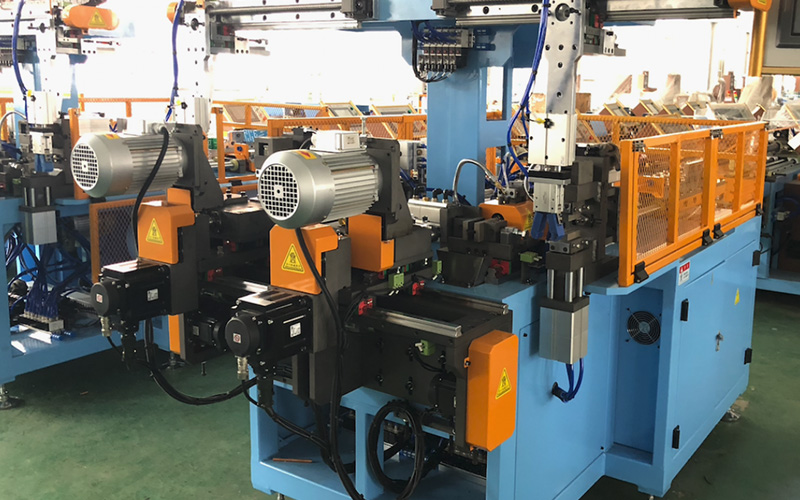
CNC tube bending is a tube-bending process that integrates computer-controlled machines to manage tool movement, speed, and pressure. The system adjusts multiple dies and axes simultaneously, enabling consistent and complex bends with minimal human error.
This method works well in automotive, aerospace, and manufacturing sectors where precision and repeatability are critical. Stored digital programs ensure identical bends across production runs.
Advantages of CNC tube bending:
- High repeatability and automation
- Reduced setup time for large batches
- Capable of multiple complex bends per part
Disadvantages of CNC tube bending:
- Higher initial machine investment
- Requires skilled operators for programming and maintenance
Stretch Bending
Stretch bending is a tube-bending process that pulls the tube while bending it around a fixed form die. The combination of tension and forming pressure reduces wrinkling and produces smooth curves with uniform thickness. This technique works best for large-radius bends and visible structural parts where surface quality matters.
Industries use it to make frames, window profiles, and aircraft components. Stretch bending machines often use hydraulic or electric systems that adjust tension and angle precisely.
Advantages of stretch bending:
- Maintains consistent wall thickness
- Produces smooth, accurate bends
- Minimizes springback
Disadvantages of stretch bending:
- Limited to larger bend radii
- Requires strong, ductile materials such as aluminum or mild steel
Ram (Push) Bending
Ram bending, sometimes called push bending, is a tube-bending process that forms a tube by pressing it into stationary dies using a central ram. This simple process often appears in workshop setups or mass production where speed outweighs precision.
It suits wide-diameter or thick-wall pipes and works well for low-cost applications like handrails or frames. Compared to rotary draw or mandrel tube bending, the resulting bends may show flattening or ovality when tighter radii are attempted.
Advantages of ram bending:
- Fast and economical
- Simple tooling requirements
Disadvantages of ram bending:
- Lower accuracy
- Limited control over wall thinning and shape consistency
Heat-Assisted (Hot) Bending
Heat-assisted or hot bending raises a tube’s temperature to make it more ductile before bending. Using induction coils, gas flames, or furnaces, the process softens the metal, allowing bends with smaller internal stresses.
This method enables large-radius or thick-walled components often used in oil, gas, and power systems. It also complements mandrel bending for alloys that risk cracking when cold-formed.
Advantages of heat-assisted or hot bending:
- Reduces bending force
- Handles heavy sections effectively
- Allows complex shapes without major wall collapse
Disadvantages of heat-assisted or hot bending:
- Requires controlled heating and cooling
- May alter material properties if not managed properly
How to Choose the Right Tube Bending Method?
1.Identify the Tube Material Type
Different materials react differently to bending forces. Softer metals like aluminum or copper deform easily, while stainless steel and titanium need more support, often through mandrel bending to prevent wrinkling or collapse.
2.Check Wall Thickness and Tube Diameter Ratio
Thin-walled tubes can lose shape under compression. Using tools like mandrels and wiper dies helps maintain roundness during bending. A thicker wall allows more freedom with radius selection and reduces the risk of cracking.
3.Determine the Required Bend Radius (CLR)
Tight-radius bends require precise control. Rotary draw bending works well for small center-line radii (CLR) where the bending die defines the curve accurately. Larger-radius bends can use simpler methods such as compression or roll bending.
4.Define Precision Requirements & Tolerances
Projects that demand precision tube bending, such as automotive or aerospace parts, need consistent geometry and wall thickness. Mandrel bending provides this accuracy by supporting the inner wall and reducing ovality.
5.Consider Production Volume & Repeatability
High-volume production benefits from repeatable, automated systems. Machines that use rotary draw or CNC setups maintain uniform bends and reduce manual error. Low-volume or custom work may rely on manual or press bending for flexibility.
6.Match Applications to the Suitable Bending Method
Each method suits specific uses:
| Method | Best For | Key Features |
| Rotary Draw | Tight radii, precision parts | Accurate, uses dies and mandrels |
| Mandrel | Thin walls, smooth bends | Prevents wrinkles, supports ID |
| Compression | Simple curves, low cost | Faster for general fabrication |
What are Common Tube Bending Defects and How to Prevent Them?
Common tube bending defects include wrinkling, flattening, cracking, springback, and ovality. These flaws appear when material stresses are not balanced across the inner and outer walls during bending. Proper control of tooling, machine settings, and material selection helps avoid most of them.
Wrinkling occurs along the inner radius when compression causes the wall to buckle. Using a mandrel—a rod inserted inside the tube for internal support—and a wiper die placed behind the tangent point helps control this issue. Thin-wall tubes benefit most from precise die setup and adequate lubrication.
Flattening and ovality develop when the circular cross-section distorts into an oval. A well-fitted bending die and correct centerline radius (CLR) limit these issues. Operators often use a ball mandrel or booster system on tube bending machines to maintain shape during tight-radius bends.
Cracking usually appears on the outer radius when tensile stress exceeds the material’s ductility. Increasing tube wall thickness, using heat-treated material, or selecting a larger bend radius reduces this risk. Smooth dies and proper lubrication also prevent micro-tears during forming.
Springback happens when a tube slightly returns to its original shape after release. CNC-controlled tube bending machines compensate by overbending the targeted angle. For high-strength alloys, real-time angle feedback ensures accurate results.

Which Bending Types Avoid Defects?
Mandrel bending prevents wrinkles and ovality by supporting the tube internally. Rotary draw bending provides precision using fixed dies and accurate control of tension and compression.
For thick-wall or large-diameter tubing, press bending and roll bending distribute forces gradually to avoid cracking. Compression bending, however, is less suited to thin or hard materials because it can increase flattening.
High-production industries often use CNC mandrel tube bending machines with wiper dies and pressure die assists to achieve repeatable accuracy. Using these setups keeps wall thinning and springback within acceptable tolerance across multiple bend cycles.
What are Materials Used in Tube Bending?
Materials used in tube bending come in:
- Steel
- Stainless steel
- Aluminum
- Copper
Tube bending uses metals and alloys that combine strength with flexibility. The most common materials are steel, stainless steel, aluminum, and copper. Each has traits that affect how it bends, such as ductility, tensile strength, and yield point.
Steel provides strong structural support and is widely used for construction, industrial equipment, and automotive frames. Its durability allows it to keep form under pressure but may need more force to achieve tight bends.
Stainless steel resists corrosion and offers good ductility, making it ideal for exhaust systems, fuel lines, and aerospace components. It holds precise shapes well but can spring back after bending if not properly controlled.
Aluminum is lightweight and easy to shape, suited for hydraulic systems, aircraft tubing, and prototypes. Its high formability helps achieve large-radius bends, though it is softer than steel and may wrinkle without proper support tools.
Copper bends easily and conducts heat and electricity, fitting for HVAC tubing, fuel distribution, and industrial fluid systems. However, its softness means it can deform under high pressure or close-radius bends.
Frequently Asked Questions
Tube bending relies on precision, the right tooling, and the proper method for each material and wall thickness. Accuracy, wall support, and the difference between tubes and pipes each influence how manufacturers select bending techniques for specific industrial or structural uses.
What is the most accurate tube bending method?
Rotary draw bending is considered the most accurate method for forming tight, repeatable bends with clean surfaces. It works by securing the tube around a bend die while a pressure die and clamp apply controlled force.
This technique allows for consistent wall thickness and precise geometries, making it suitable for automotive frames, aerospace tubing, and hydraulic lines. CNC rotary systems further improve accuracy by programming angles and radii to tight tolerances.
What type of bending is used for thin-wall tubing?
Mandrel bending is preferred for thin-wall tubing because it prevents wrinkling, collapsing, or flattening during the bend. A mandrel, placed inside the tube, supports its interior surface as it curves around the die.
This setup distributes stress evenly and maintains the tube’s round shape. It is widely used for stainless steel or aluminum tubes in industries like HVAC, furniture, and exhaust system manufacturing.
Is pipe bending the same as tube bending?
Pipe bending and tube bending follow similar forming principles but serve different purposes. Pipes are sized by nominal measurements and used mainly for transporting fluids or gases. Tubes, on the other hand, are sized by their outside diameter and often serve structural or mechanical functions.
Although both can use hot or cold bending methods, tubes require tighter tolerances and smoother finishes. These differences in sizing and application determine the equipment and standards used in each process.
Want to Know More About Our Products?
View All Products Now